
A preserved expedition record. Dates, ages, roles and descriptions reflect the original account; references to live activities describe that period.
Date and time: 1 May 2012
Written by: Mike Bodnar, Crew 118, First Officer
Until humans actually land on Mars and explore it, we have to rely on remotely operated rovers, such as Spirit and Opportunity to scout the surface. The twin rovers far outlasted their original lifespan and have sent back some incredible imagery. They have also travelled much further than was ever planned.
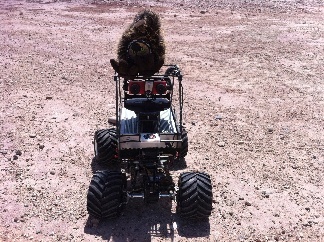
Today we activated the Hab's remote controlled rover, which is here courtesy of the Northern California branch of the Mars Society.
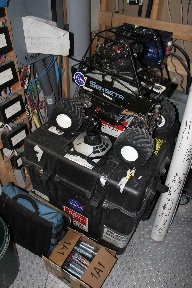
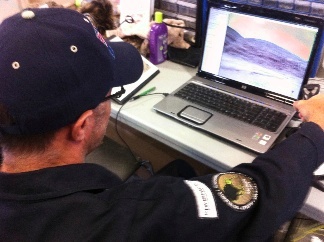
After charging up the batteries and following the manual on how to boot up the rover's CPU, we successfully deployed the microwave-sized four-wheeled vehicle onto the surface, and watched on a laptop from inside the Hab as we steered it across the terrain.
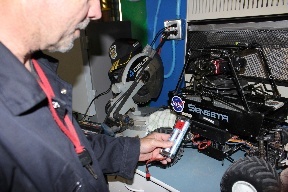
In real life, rovers on Mars are not steered with a joystick like we used; due to the time delay of transmission to Mars the rovers there follow a pre-programmed packet of instructions uploaded daily, and move at snail's pace.
Our real-time rover is much more responsive and faster, with the onboard live-streaming camera showing the ground in front, the sides, above or below depending on where we point it. But the one thing it does have in common with the Martian rovers is that the surface imagery looks just like Mars.
INSERT MOVIE HERE
With limited wireless range, our rover won't be trundling too far from base, but tomorrow I plan to hide some 'concretions' somewhere near the Hab and see if any of the other crew can find them via the rover. Concretions are small globe like balls of stone (often hematite) created, it's thought, over time in a similar way that a pearl is created from a grain of sand. Since they can form in water, finding them is a good indication that water might once have been present, and in fact there are plenty to be found near the Hab, especially on the path up to the observatory.
Unfortunately our little rover isn't a great climber, so I will place some on the flat. Then we will have to see if any of the KiwiMars crew can find "evidence" of water on our little corner of Mars...
ENDS.